
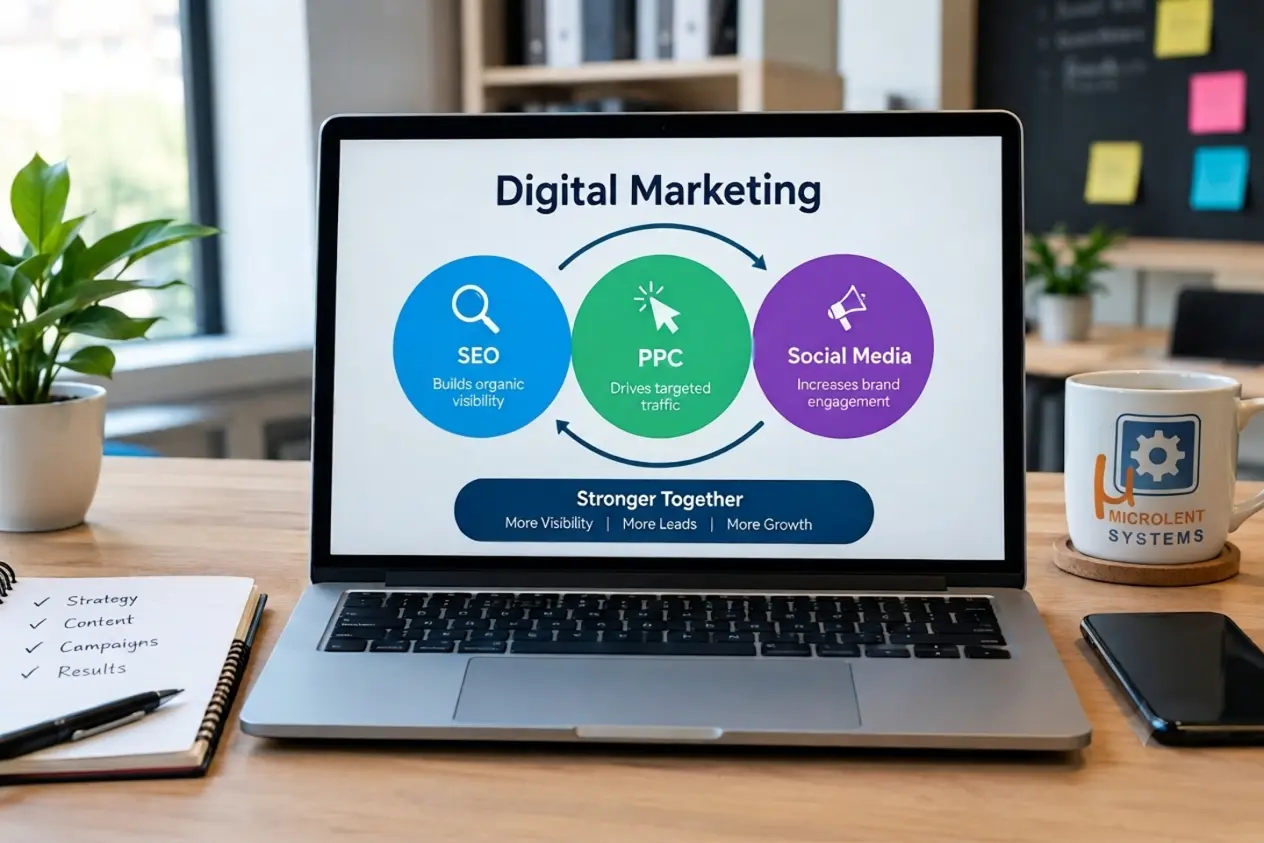
Digital marketing in 2026 is no longer about choosing one channel and ignoring the others. People may discover a business through Google, see its social media content later, click a paid advertisement, read a blog, compare alternatives, and finally return through an organic search before becoming a customer.
That makes SEO, PPC, and social media marketing three connected parts of a broader digital marketing strategy.
SEO helps businesses build long-term organic visibility. PPC provides targeted paid exposure and faster feedback. Social media helps businesses build awareness, engagement, trust, and additional discovery opportunities. When these channels share data, messaging, content, and audience insights, they can support the same customer journey rather than operating as separate marketing activities.
|
Ready to Strengthen Your Digital Marketing Strategy? Have a Question? Talk to our team about your SEO, PPC, social media, or overall digital marketing requirements. |
What Is SEO and Why Is It Still Relevant in 2026?
Search engine optimization (SEO) is the process of improving a website and its content so that it can appear more prominently for relevant searches.
In 2026, SEO is still relevant, but the search environment has changed. Users increasingly interact with AI-powered search experiences, AI Overviews, and conversational search platforms in addition to traditional search results. Search queries are also becoming more detailed and question-based.
Is SEO still relevant in 2026?
Yes. SEO remains important in 2026, but businesses need to optimize for more than traditional keyword rankings.
Modern SEO should consider:
- Search intent rather than keywords alone
- Helpful, original and trustworthy content
- Technical website performance
- Internal linking and topical authority
- Structured content that answers specific questions
- Local search visibility
- AI search and answer-engine visibility
- User experience and conversion paths
For example, instead of creating several pages simply targeting variations of “SEO services,” a business can build a useful content cluster answering questions about SEO strategy, local SEO, technical SEO, AI search, content optimization, and measuring organic performance.
This approach can help a website become useful not only to traditional search engines but also to answer engines that extract information from authoritative sources.
What Is PPC and How Does It Support Digital Marketing?
Pay-per-click (PPC) advertising allows businesses to pay for targeted placements on search engines, social platforms, and other advertising networks. Businesses can target specific keywords, audiences, locations, interests, or behaviors depending on the platform.
PPC is particularly useful when a business needs visibility quickly. A new service page, product, location, or campaign does not necessarily have to wait for organic rankings before receiving targeted traffic.
However, PPC is not simply a replacement for SEO.
Is PPC better than SEO?
Neither PPC nor SEO is universally better. They serve different purposes and work best when selected according to a business's goals, timeline, competition, and budget.
SEO is generally designed for sustainable organic visibility, while PPC can provide immediate exposure and controlled targeting.
The more useful question is:
Where can SEO and PPC complement each other?
PPC can provide valuable information that SEO teams can use. For example, paid campaigns can reveal which search terms generate clicks, leads, or sales. Those insights can influence future content, landing pages, and SEO priorities.
The relationship can also work in reverse. SEO research can reveal long-tail searches, questions, and customer language that can inspire new PPC ad groups and messaging.
This creates a continuous feedback loop:
PPC data → SEO insights → better content → stronger organic visibility → improved audience understanding → better paid campaigns
Research on 2026 PPC trends also highlights AI-assisted campaign management, automation, measurement changes, and AI-generated creative as important areas for advertisers to monitor.
Why Social Media Marketing Matters in 2026
Social media marketing is no longer limited to posting content and collecting followers. Social platforms increasingly function as discovery, search, content, community, advertising, and commerce channels.
Current 2026 research indicates that social search is becoming an important part of how consumers discover information, particularly among younger audiences. Short-form video also remains a major content format, while AI is increasingly embedded in marketing workflows.
Social media can therefore contribute to several stages of the customer journey:
Awareness → Engagement → Discovery → Website Visit → Remarketing → Conversion
A business might publish an educational video explaining a common customer problem. Someone sees it on social media, searches the brand later, finds an organic blog through Google, and eventually clicks a paid campaign offering a consultation.
That customer may interact with all three channels before converting.
Which is better, SEO or social media marketing?
There is no universal winner because SEO and social media perform different roles.
SEO is particularly useful for capturing people who are actively searching for information or solutions.
Social media marketing can help create awareness, build communities, distribute content, and reach people before they perform a traditional search.
The strongest strategy can use both:
Social media creates attention → SEO captures search intent → PPC supports conversion and remarketing.
How SEO, PPC and Social Media Marketing Work Together
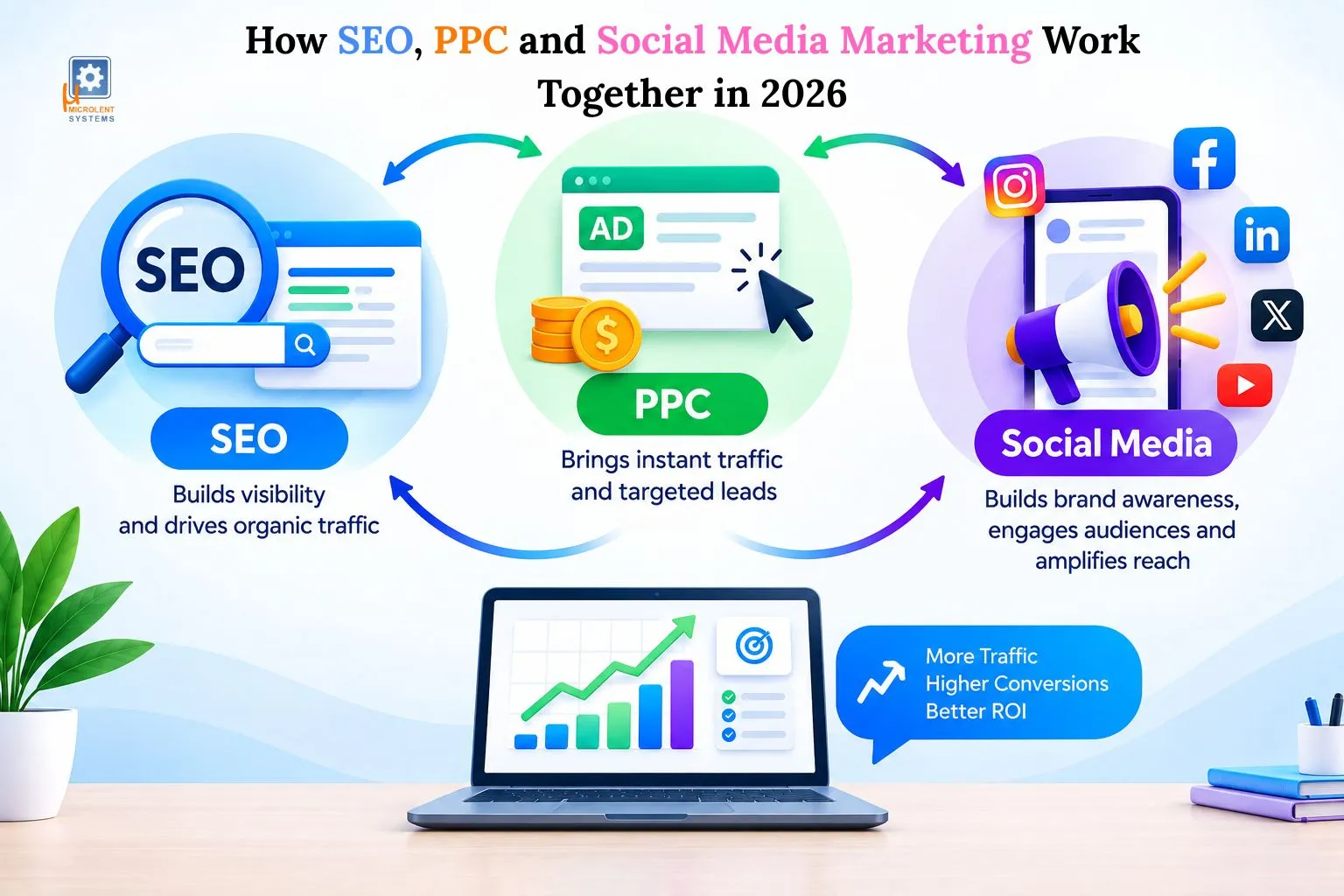
The real value comes from integration.
1. Use SEO to build long-term visibility
Create useful content around the questions and problems your target customers search for.
For example:
- How much does custom software development cost?
- How do AI agents work in enterprise software?
- What is the difference between SaaS and custom software?
These articles can attract informational traffic and build topical authority.
2. Use PPC to accelerate high-intent opportunities
PPC can target commercial searches while organic content is developing.
For example, a software development company could use paid search for terms related to custom software development while its SEO team builds long-term organic visibility around the same topic.
3. Turn SEO content into social content
A detailed blog does not have to remain a single webpage.
One article can become:
- LinkedIn posts
- Short-form videos
- Instagram content
- Infographics
- Social carousels
- FAQ posts
- Industry insights
This extends the value of SEO content to social audiences.
4. Use social engagement to improve paid campaigns
Social media can reveal which topics, messages, videos, or customer problems generate engagement.
Those insights can help shape PPC creative and landing-page messaging.
5. Retarget interested audiences
Someone may discover a business through an organic blog but leave without converting.
A relevant PPC or social retargeting campaign can bring that visitor back with a useful offer, case study, consultation, or service-related message.
A Simple Example of Integrated Digital Marketing
Imagine a software development company launching an AI development service.
The company could:
SEO:
Publish guides about AI agents, AI integration, enterprise AI, and AI application development.
PPC:
Run search campaigns for high-intent AI development queries.
Social Media:
Share AI trends, short videos, project insights, statistics, and educational content.
Retargeting:
Show relevant ads to visitors who read AI-related articles but did not contact the company.
Conversion:
Direct qualified visitors to an AI development service page with a clear enquiry or consultation
option.
Instead of three independent campaigns, the company creates one connected customer journey.
Why Businesses Should Combine the Three Channels in 2026
A combined approach provides several practical advantages:
Better audience understanding
SEO shows what people search for. PPC provides rapid performance feedback. Social media reveals engagement and content preferences.
More consistent messaging
When the same value proposition appears across search results, advertisements, social content, and landing pages, customers receive a more consistent brand experience.
More opportunities to reach customers
A potential customer may encounter a company through organic search, paid advertising, social media, or multiple channels. Combining them increases the number of meaningful touchpoints.
Better content reuse
A strong SEO article can become social content, paid creative ideas, email content, videos, and sales resources.
More informed marketing decisions
Instead of evaluating each channel in isolation, businesses can analyze how different channels contribute to the overall customer journey.
SEO, PPC and Social Media: A Unified Strategy for 2026
The biggest mistake is treating SEO, PPC, and social media marketing as competing channels.
They can perform different jobs within the same digital marketing strategy:
|
Channel |
Primary Role |
Typical Strength |
| SEO | Capture organic search demand | Long-term visibility |
| PPC | Capture targeted paid demand | Faster reach and testing |
| Social Media | Build awareness and engagement | Discovery and community |
| Retargeting | Re-engage interested users | Supporting conversions |
| Content Marketing | Educate and build authority | Supports all channels |
The goal is not necessarily to divide a marketing budget equally between them. Instead, businesses should identify where each channel contributes to the customer journey and use performance data to adjust the strategy.
Conclusion
SEO, PPC, and social media marketing each have a different role in digital marketing, but their impact can become stronger when they operate together.
SEO builds sustainable organic visibility. PPC provides targeted and measurable paid exposure. Social media creates awareness, engagement, and additional discovery opportunities.
In 2026, businesses also need to account for AI-powered search, changing user behavior, social search, automation, and increasingly complex customer journeys.
Rather than asking whether SEO, PPC, or social media is the single best channel, businesses should ask how these channels can share insights and support one another.
A well-connected strategy can turn search visibility, paid advertising, social engagement, content, and remarketing into one coordinated digital marketing system—giving customers multiple useful ways to discover, evaluate, and engage with a business.
Frequently Asked Questions
Is SEO still relevant in 2026?
Yes. SEO remains relevant, but it has expanded beyond traditional rankings. Businesses now need to consider search intent, helpful content, technical performance, local visibility, and AI-powered search experiences.
Is PPC better than SEO?
Neither is universally better. PPC can provide faster visibility and testing, while SEO can build long-term organic visibility. Using both can help businesses address different stages of the customer journey.
How do PPC and SEO work together?
PPC can provide fast keyword and conversion data that informs SEO content and landing-page strategies. SEO can also identify search topics and customer language that can improve PPC campaigns.
Which is better, SEO or social media marketing?
SEO and social media have different purposes. SEO primarily captures existing search demand, while social media can create awareness, engagement, discovery, and community. Combining both can create a broader digital marketing presence.
Can social media improve SEO?
Social media can help distribute content, increase brand awareness, generate engagement, and potentially attract visits, mentions, and links. These activities can support a broader SEO and digital marketing strategy, although social engagement itself should not be treated as a direct organic ranking factor.
What is the best digital marketing strategy for 2026?
There is no single strategy that fits every business. A practical approach is to combine SEO, PPC, social media, content marketing, analytics, and conversion optimization according to the business's audience, goals, competition, and customer journey.