

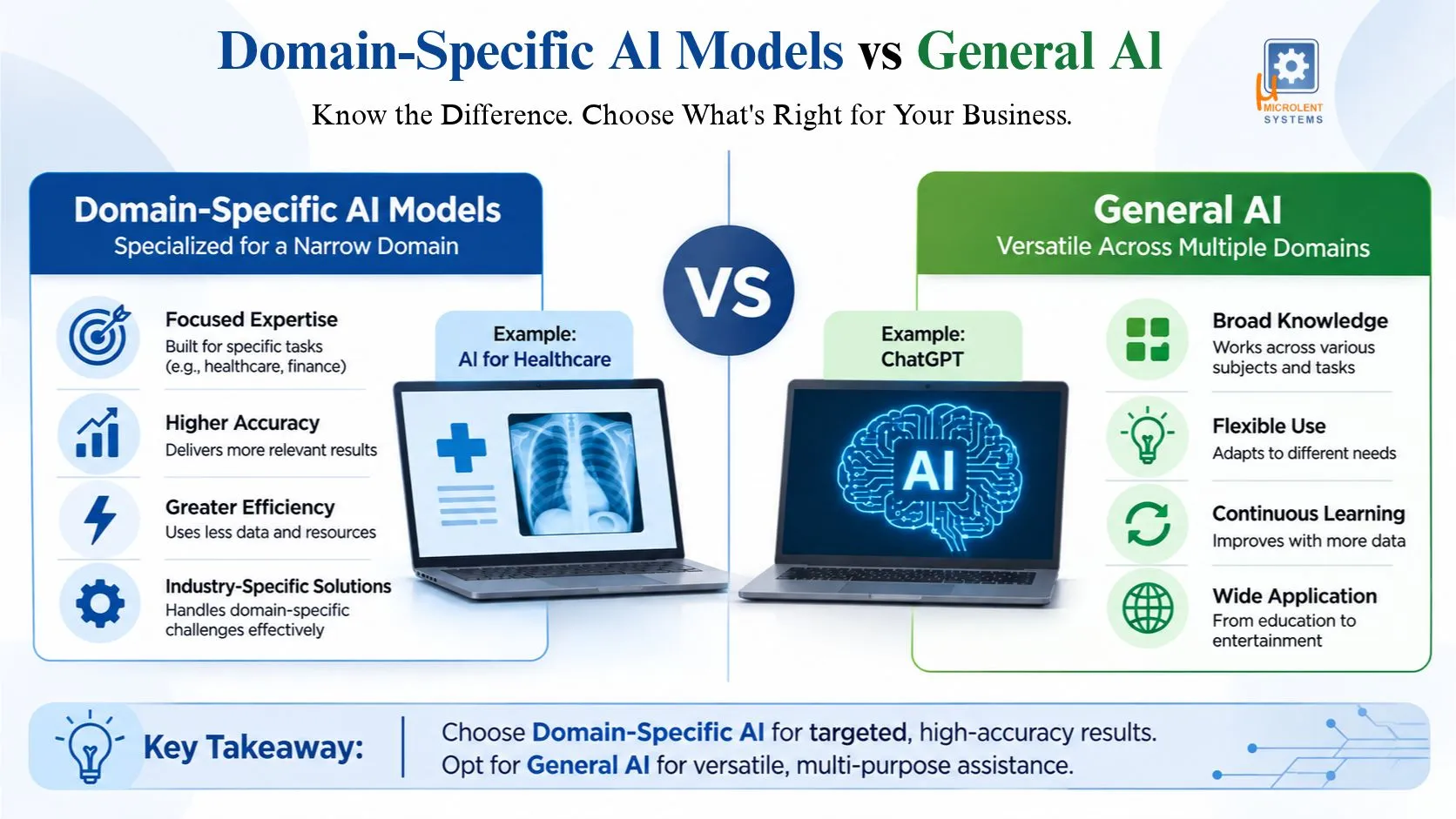

Quick answer: For most businesses, domain-specific AI models are the better choice. They are trained on industry data, so they deliver higher accuracy, fewer hallucinations, stronger compliance and faster ROI in workflows like finance, healthcare, legal and manufacturing. General-purpose AI models still work well for broad, low-risk tasks like drafting and brainstorming, but when accuracy and regulation matter, industry-specific AI solutions win.
Every business now faces the same question: use one all-purpose AI tool or invest in tailored ones? This guide compares domain-specific AI models and general-purpose AI models so you can choose with confidence.
What Are General-Purpose AI Models?
General-purpose AI models are trained on huge, mixed datasets. They can write emails, summarize reports, generate code and answer questions on almost any topic. Their strength is breadth. Their weakness is depth: they know a little about everything, and they can produce confident answers that are wrong.
What Are Domain-Specific AI Models?
Domain-specific AI models are trained or fine-tuned on data from one field, such as law, healthcare, finance or manufacturing. They learn the jargon, formats and rules of that field. Teams build them in several ways: training from scratch, fine-tuning an existing model, connecting it to a trusted knowledge base (retrieval-augmented generation), or combining these approaches.
Packaged as industry-specific AI solutions, these models arrive ready to plug into real workflows such as claims processing, compliance checks or predictive maintenance.
|
Not Sure Which AI Model Fits Your Business? Our AI experts will review your workflows and recommend the right mix of domain-specific and general-purpose AI. Get a free consultation today.WhatsApp Now Call Now |
Domain-Specific vs General AI: Key Differences
|
Factor |
Domain-Specific AI Models |
General-Purpose AI Models |
| Training data | Curated industry data | Broad internet-scale data |
| Accuracy in niche tasks | High, with fewer hallucinations | Variable; can sound right but be wrong |
| Industry jargon | Understands terminology and context | Often misreads specialized terms |
| Compliance fit | Built around regulations (HIPAA, GDPR, financial rules) | Needs extra controls and review |
| Setup effort | Low if pre-trained; moderate if custom | Low to start, high to adapt for niche use |
| Cost | Higher upfront, lower per-task cost at scale | Low entry cost, rising customization cost |
| Flexibility | Narrow and deep | Wide and shallow |
| Best for | Regulated, high-stakes workflows | Brainstorming, drafting, general support |
Choose Domain-Specific Al for precision in specialized, regulated domains, and General-Purpose Al for broad, flexible assistance.
Why Businesses Choose Domain-Specific AI
1. Better accuracy where mistakes are costly. In healthcare billing, a wrong code means a rejected claim. In finance, a missed rule means a compliance breach. Specialized models reduce this risk because they are grounded in verified, relevant data.
2. Stronger compliance. Regulated industries need outputs that follow strict rules. Models tuned to those rules make audits easier.
3. Faster time to value. Pre-trained industry-specific AI solutions skip much of the retrofitting that general models require, so teams can prove ROI sooner.
4. A compounding advantage. As a specialized model absorbs your processes and terminology, its outputs get more useful over time.
Industry analysts expect this shift to continue. By 2027 more than half of the generative AI models enterprises use will be domain-specific.
When General-Purpose AI Still Wins
General-purpose models remain the smarter choice when:
- Tasks are broad: marketing copy, brainstorming, meeting summaries.
- Stakes are low and a human reviews every output.
- You are experimenting and don’t yet know the use case.
- Budget is tight and no specialized model exists for your niche.
Examples of Domain-Specific AI
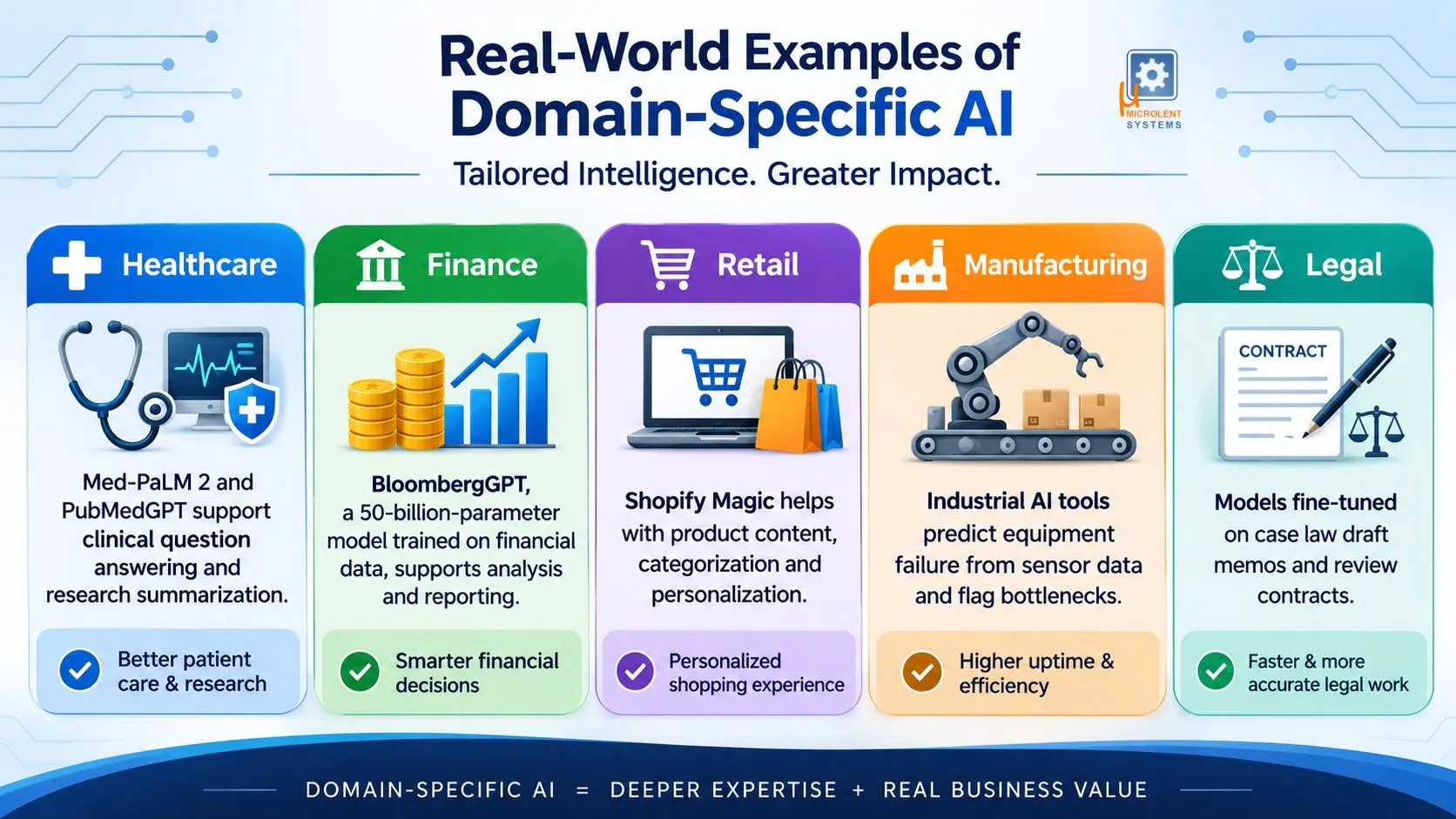
- Healthcare: Med-PaLM 2 and PubMedGPT support clinical question answering and research summarization.
- Finance: BloombergGPT, a 50-billion-parameter model trained on financial data, supports analysis and reporting.
- Retail: Shopify Magic helps with product content, categorization and personalization.
- Manufacturing: Industrial AI tools predict equipment failure from sensor data and flag bottlenecks.
- Legal: Models fine-tuned on case law draft memos and review contracts.
How to Choose the Right Model
Ask four questions:
- How costly is an error? High cost points to domain-specific AI.
- Are there regulations? If yes, favor specialized models with governance.
- Do you have quality proprietary data? If yes, fine-tuning or retrieval pays off.
- Is the task repeatable? Repetitive workflows benefit most from specialization.
A practical approach is hybrid: use general-purpose AI models for everyday productivity and industry-specific AI solutions for core, high-risk processes.
Conclusion
Domain-specific AI models and general-purpose AI models solve different problems. General models offer flexibility and a low barrier to entry. Domain-specific models deliver accuracy, compliance and measurable ROI in specialized workflows. Most businesses should use general AI for broad productivity and invest in industry-specific AI solutions where precision matters most. Start with one high-value workflow, measure the results, and expand from there.
Frequently Asked Questions
1.Which AI model is best for business strategy?
For early-stage strategy work such
as brainstorming, market summaries and scenario drafting, a general-purpose model is a good thinking
partner. For decisions that depend on regulated data, financial modeling or industry benchmarks, a
domain-specific model grounded in your own data gives more reliable input. Treat both as advisors, not
decision-makers.
2.Can you provide examples of domain-specific AI?
Yes. Med-PaLM 2 and PubMedGPT
(healthcare), BloombergGPT (finance), Shopify Magic (e-commerce), and predictive maintenance systems in
manufacturing are common examples.
3.What makes an AI model domain-specific?
It is trained, fine-tuned or connected
to curated data from one industry, so it handles that field’s terminology, formats and rules better than
a broad model.
4.Are domain-specific AI models more expensive than general AI?
Upfront costs can
be higher, especially for custom builds. Pre-trained or retrieval-based options narrow the gap, and
total cost often drops because less rework and error correction is needed.
5.Can a general-purpose AI model be made domain-specific?
Yes. Common routes
include prompt engineering, retrieval-augmented generation and fine-tuning. Each trades off cost, speed
and control differently.
6.Do domain-specific AI models eliminate hallucinations?
No. They reduce them in
their field, but no model is error-free. Benchmarks, fact-checking against trusted sources and human
review remain essential.
7.How do I measure whether a domain-specific model is working?
Track task-level
metrics such as accuracy, precision, recall and latency, plus business results like error reduction,
automation rate and ROI.